|
||||||||
OLDS ELEVATOR™ PublicationsA Radical Approach to the Vertical Conveyance of Bulk Materials: the OLDS ELEVATOR™
8. Research and development Larger diameter units
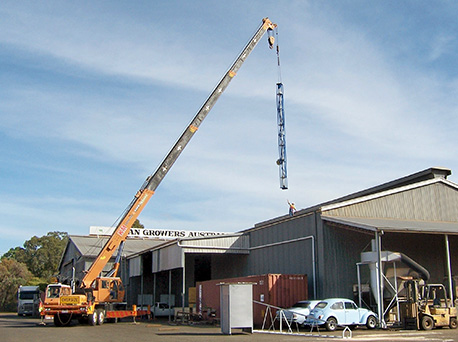
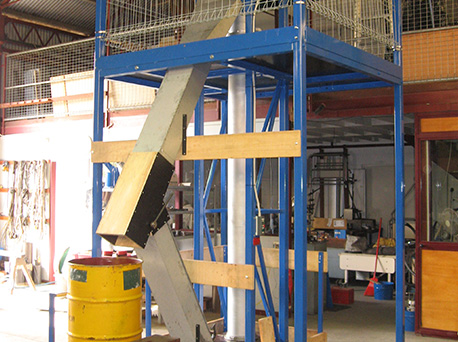
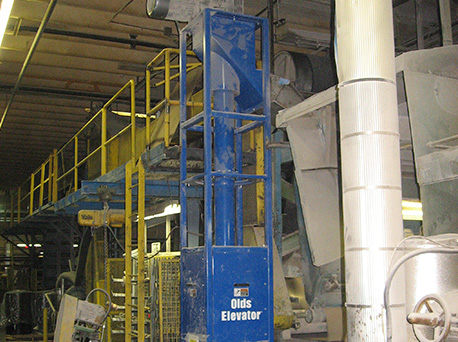
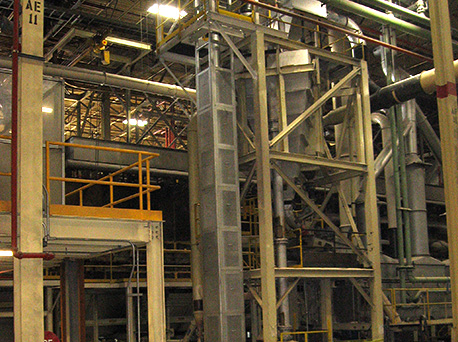
Tests with the 254 mm (10") diameter machine indicate the OLDS ELEVATOR™ can be successfully scaled up to handle larger industrial applications. This will require solids handling engineers to rethink their plant designs to take advantage of the elevation and metering capabilities of this unique tool. This will require larger licensed manufacturing partners to be selected, as well as redesigning of bearings and drive systems (figures 18, 19). ![]() Documenting volumetric feeding accuracy Early trials documenting the OLDS ELEVATOR™'s accuracy and repeatability as a volumetric feeder were conducted with silica sand. Although initial testing and measurement methods were relatively crude, the accuracy and repeatability of the flow rate control of the OLDS ELEVATOR™ was evident. Improved measurement techniques are to be employed to secure more accurate measurement data. A database of flow rate accuracy and repeatability is to be compiled to cover a broad range of bulk material types. This database will guide the direction of industrial applications that may benefit by the simplicity of this innovation. Predicting and controlling component wear To date, the only wear items on these elevators have been the screw and the intake scoops. Intake scoops are inexpensive and readily replaceable parts. Screw wear is greatest at the lower end, where material enters the elevator and changes direction. Recent designs employ screws made in multiple segments so the bottom segment can be removed and replaced independently. Tests with various abrasion resistant materials, variable screw configurations, including the double helix, will allow wear rates to be predicted and countered by specifying the most suitable materials and configurations for specific applications. Purging the elevator for product changeovers All mechanical elevators leave residue in the machine at the end of a run. Reversing the casing to empty residual product back into the hopper may purge short OLDS ELEVATORS™ up to 152mm (6") diameter. As elevators grow in diameter and height this residual volume will become several times the volume of the feed hopper. However, whereas it is difficult to empty other mechanical elevators, removing the bottom flange allows the contents of an OLDS ELEVATOR™ to be discharged into a collecting tray. ![]() Power Consumption For high lifts at large diameter the power requirements may become prohibitive for a single elevator, in which case two or more elevators might be better used. The power requirements and efficiency of large elevators need to be investigated. In-feed Pick-up scoop optimization Currently, research is being undertaken to optimize the in-feed scoop inlet geometry to improve the gentleness of handling and maximize the delivery rate. CONTINUE >> Potential Applications: A Radical Approach to the Vertical Conveyance of Bulk Materials: the OLDS ELEVATOR™ |
Engineering and Support Free Video Taped Test Materials Handled Performance Features Standard Configurations Test Laboratory OLDS ELEVATOR™ LLC 12 B Park Ave. Hudson, NH 03051 Call 603.882.8899 Fax 603.882.8855 Email us today! OLDS ELEVATOR™ Advantages 1. Olds Elevator Innovative Material Elevation
|
| Bulk Material Handling Systems | Dense Abrasives | Dust Control | Dust Explosion Prevention | Free Video Taped Test | Gentle Handling Dust-Free Elevation Materials Handled | Mobile Units | Pneumatics versus Olds Elevators | Performance Features | Standard Configurations Test Laboratory | Vertical Elevation | Volumetric Feeders | OLDS ELEVATOR™ Site Map Hudson, NH Website Design Development Dissatisfied by conventional methods with bucket elevators, screw elevators, pneumatic conveyors and inclined belt conveyors? OLDS ELEVATOR™ has |